


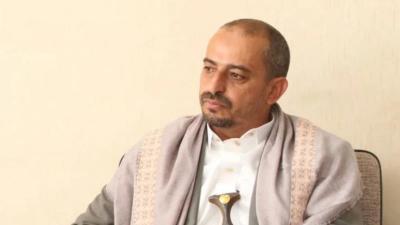
Yemen’s Foreign Minister in Interview No. 2: Israel Behind the Wars in West Asia
“Israel is the cause of the war in West Asia”
That is the view of Yemen’s Acting Foreign Minister, Abdulwahid Abu Ras, expressed in an interview with Hans Öhrn, president of the Swedish Peace Council, published in Swedish here: https://frednu.se/?p=3938. He was interviewed via video link from his office in Sana’a on 24 August.
This the second interview from Sweden. The first interview was August 16 by Ulf Sandmark, Schiller Institute in Sweden and also Board member of the Swedish Association Yemen Solidarity. https://schillerinstitutet.com/yemen-stands-up-for-peace-and-development-interview-with-yemens-foreign-minister-abdulwahid-abo-ras/
Minister Abdulwahid Abu Ras, says:
“When this entity – the Israeli enemy entity – failed over recent decades to achieve its goal of changing West Asia and establishing a ‘Greater Israel’, the United States intervened directly” .
At present, he believes that the United States has already lost the ongoing war.
“The signs of this failure are that the declared objectives have not been achieved. The US administration, together with the Israelis, declared that the main objective was to overthrow the system of government of the Islamic Republic – along with several other objectives, but this was the most prominent one,” says the foreign minister.
However, he warns that the war could resume on a full scale.
“As long as the Israelis remain in the region and the United States is able to maintain a presence in the region, the war has not ended and will not end,” he states.
Yemen’s solidarity with the struggle of the Palestinian people remains unwavering.
“We remain steadfast in our support for the Palestinian people in their ongoing suffering, and it is the Palestinians themselves who will decide how the situation should be dealt with,” says Abdulwahid Abu Ras.
He is highly critical of the way the outside world has responded to what he describes as the genocide in Gaza, and characterises the measures taken by the EU against Israel as an attempt to mislead public opinion.
“Among the foremost of these countries are France and Germany. Outside the Security Council, Germany has also adopted positions similar to those of France. For example, the French and German positions are clear and explicit when it comes to supporting the Israeli side, even though statements are sometimes made that are primarily intended to mislead public opinion – nothing more and nothing less. But in reality, support and funding are directed to the Israeli side,” says the minister.
There are other voices, but many are afraid to say what they think, according to Abdulwahid Abu Ras.
“We know that everything has a price. Many are afraid to take clear and explicit positions because they will have to pay a price. There is a Zionist lobby at the global level, particularly in the United States and then in Europe – a Zionist lobby that punishes anyone who takes a positive and humanitarian stance towards the Palestinian people.”
He is also highly critical of the actions of many countries in the region.
“At the regional level, there are several countries which, if they fulfilled their duty in the manner required, could bring the crimes against the Palestinian people to an end,” he says.
He singles out Saudi Arabia in particular, directly accusing it of supporting what he describes as Israel’s terror in Gaza and the destabilisation of the region.
“The Saudi regime indirectly finances the Israeli side. It pays trillions of dollars to Trump, and Trump transfers this money into weapons for the Israeli enemy entity, which is waging an ongoing war against the Palestinian people.”
But countries such as Egypt and Turkey could also do much more, he believes.
Abdulwahid Abu Ras almost entirely dismisses the new cooperation between Turkey, Saudi Arabia and Pakistan, the so-called Mecca Agreement. He describes the cooperation as an opportunistic alliance in which the parties are primarily trying to exploit one another for their own short-term interests.
“We regard this so-called alliance as a purely formal alliance that does not even serve the countries that are part of it.”
“There is a psychological and media dimension to this alliance, which the Saudi regime benefits from in one respect: it is trying to show that it has allies or partners who can provide it with protection for its crimes and bear the consequences and repercussions of these crimes in general.”
“We see that the other countries are trying to milk what remains of the Saudi regime’s wealth after the American side has seized enormous amounts of these assets.”
Reports recently emerged that the United States and Israel – perhaps Israel above all – are trying to draw Syria into the war against Lebanon. Abdulwahid Abu Ras is highly sceptical, but does not entirely rule out the possibility.
“It cannot be ruled out – I mean the Syrian regime, not Syria in general; the current Syrian regime, the groups that currently govern Syria.”
“It cannot be ruled out.”
“We see that the United States, with Israeli participation, has succeeded in creating certain regimes in the region which consequently serve them and carry out many of their projects for them.”
“It is not impossible that the Syrian regime could take this step.”
In this context, he also mentions “takfiri groups”, which, according to him, have previously been used to destabilise the region.
“As for the takfiri armed groups, they could be pushed forward in the same way that takfiri groups were previously mobilised, gathered from many countries in the East and West, organised and used to fight Syria until the government was overthrown, partly because of mistakes made by the government itself.”
“It is not impossible that they would take this step, but there are many variables in the region.”
Regarding the current humanitarian situation in Yemen, the minister expresses grave concern.
“First of all, regarding the humanitarian situation in Yemen, there is truly enormous suffering – suffering in every sense of the word, a genuine humanitarian catastrophe.”
“We can confirm that Yemen ranks second, directly after the suffering of the Palestinian people in Gaza.”
“Poverty has increased dramatically, the cost of living has risen, the purchasing power of Yemeni citizens has declined, and production costs have increased sharply.”
“The reasons for the precarious situation are many,” he says.
“The real causes are numerous. But among the most important, we can first mention the misguided policies of the previous regime over decades, which led the Yemeni people to the situation they found themselves in, although this did not happen in isolation.”
Added to this are the draconian sanctions against Yemen. Ships carrying supplies are blocked or delayed in other ports. Medicines are often unusable by the time they reach Yemen, as are other supplies. Yemen also has considerable oil, gas and mineral resources and could solve its economic problems through these resources, but they are now confiscated and controlled by the Saudi regime.
“Whatever we say about the suffering, we cannot fully describe it. There is suffering in every sense of the word,” Abdulwahid Abu Ras concludes.
Hans Öhrn
Read the full transcript of the interview below
Note: Abdulwahid Abu Ras is Foreign Minister of the so-called National Salvation Government, which was formed in Sana’a in November 2016 by the Houthi-led Ansar Allah movement and the then Saleh-loyal wing of the General People’s Congress (GPC). The government was led by Abdulaziz bin Habtour. Following the split between the Houthis and Ali Abdullah Saleh in 2017, Ansar Allah came to dominate the government and state institutions in Sana’a. Around 80 per cent of Yemen’s population lives in the part of the country controlled by the National Salvation Government, making it Yemen’s de facto government – a term also used by the United Nations.
The internationally recognised government, led by the eight-member Presidential Leadership Council (PLC), has its interim seat in Aden but is in practice heavily dependent on Saudi Arabia and spends considerable time in Riyadh. It is therefore often referred to as the “hotel government”.
Full Transcript of the interview with the minister by Hans Öhrn: Translated from Arabic
Sunday 23-August-2026
Minister (Arabic):
Welcome, Mr. Hans. We apologize for the delay, welcome.
Mr. Hans Öhrn:
No problem. Thank you, Minister. I’m glad and grateful to have the opportunity to speak with you at a time when Yemen no longer is merely part of a local conflict, but has become a central actor in a wider regional crisis and with global consequences.
Minister:
Yes, please go ahead, go ahead. We are also happy with this meeting, and we are keen to ensure that the voice—our voice—reaches you, reaches partners like you, reaches the international community, and reaches European societies in particular; that the voice arrives without any distortion, and we are happy with this meeting.
Mr. Hans Öhrn:
Thank you, Minister. Please let me start with a broad question. How do you assess the situation, or how do your government assess the situation in the region that has developed since the United States and its Zionist entity brutally attacked once again Iran in the beginning of this year?
Minister:
Yes, first of all, the region was not in a state of real stability even before the recent attack. The presence of the Israeli entity in the region has created a state of instability throughout the past decades. At times, it manifested clearly and publicly in the form of crimes, wars, violations, and genocides, and at other times, it shifted into other subversive activities, actions, economic warfare, and tearing the social fabric within our region’s societies. When the entity—the Israeli enemy entity—failed over past decades to achieve its goal of changing the Middle East and establishing Greater Israel, the Americans intervened directly. This intervention took the form of an unprecedented war. This war targeted more than one country in the region, but in an unprecedented, most brutal, and unique manner, it targeted the Islamic Republic of Iran with a declared, unprecedented war in every sense of the word, without any justification. The criminal Trump did not even need international legitimacy, he did not need the Security Council, he did not need the United Nations, nor did he need anyone; rather, he wanted others to move according to his whims and desires. So, as we said, the region was not in a state of stability, and after that, even before the aggression on Iran, the genocide against the Palestinian people began—the greatest human disaster in modern history in every sense of the word occurred in Gaza. All human values and principles were buried under the rubble in Gaza, international law was buried, and there was a shameful, horrific, and absolute silence from everyone in dealing with these crimes committed in Gaza. Therefore, the region was fundamentally not stable, but the intensity of the targeting against the region increased. We see that the fierceness of this targeting has been present since after October 7th, Operation Al-Aqsa Flood, and the targeting of Palestinians. Now, what resulted from this targeting is a altered reality; we can say there are indicators of a radical change at the regional level, certainly not in favor of the Americans or the Israelis, but in favor of the free people of this region, which is another axis we can speak about later.
Mr. Hans Öhrn:
Thank you, Minister. Your government has previously linked its action in the Red Sea to the situation in Gaza. How do you see that relationship today?
Minister:
The relationship remains as it was; nothing has changed. The calming of the Yemeni position was based on what occurred in the agreement—the so-called agreement—even though the Israeli side did not abide by this agreement in the first place. So Yemen’s position remains declared: we stand alongside the Palestinian people in their ongoing suffering, and the decision here is subject to the Palestinian side. In the event that the Palestinians decide to confront the failure to abide by the agreement and move toward escalation until these crimes are stopped, Yemen’s position is the exact same previous position and has not changed at all. On the contrary, we are fully prepared to make stopping the genocide and ongoing crimes against the Palestinian people a priority for us in Yemen, even above our internal issues and suffering at the level of the Yemeni people.
Mr. Hans Öhrn:
Thank you, Minister. In your view, what responsibility do regional actors have in preventing further escalation, or what can they do? Can they do something?
Minister:
Yes, at the regional level, there are several countries that, if they fulfilled their duty as required, the crimes against the Palestinian people would stop. The Saudi regime comes at the forefront, as well as the Turkish role, the Pakistani role, and one of the most important roles, the Egyptian role. However, we notice that there is a range between those who are negligent and those who are more complicit; we notice that the Saudi regime is complicit. The Saudi regime indirectly funds the Israeli side; it pays trillions of dollars to Trump, and Trump transfers these funds into weapons for the enemy Israeli entity, which is waging an ongoing war on the Palestinian people.
Likewise, there is negligence from regional countries. For example, the coalition that was recently formed—if its priorities were stopping the crimes in Palestine, it would have achieved great success and stopped the criminal Netanyahu from committing further crimes. But there is an attempt to divert attention and turn the compass toward other parties, and this is the negative role of the regional states. Internationally, if we look at the United States of America, it is the one waging this war, leading this war, and is a partner to the Israeli in every detail—starting from the political stance, coverage, and international legitimacy, all the way to direct military action and continuous funding. And if we look at other countries like Russia or China, positive stances are issued by them, but they do not go beyond statements; they do not exceed that.
Likewise, the European side: there are varying positions among Union members even within the EU. For example, the French and German stances are clear and explicit in standing with the enemy Israeli entity, even if statements are occasionally issued to throw dust in people’s eyes, nothing more, nothing less. But in reality, support and funding are directed to the Israeli side. Following them is the British side outside the EU, standing with the American in all the crimes committed by the enemy Israeli entity in Palestine. There are indeed positive stances within Europe, but as we said, they do not go beyond statements, and there are some actions, but they are timid steps, such as those taken at times by Spain and some European countries. This is a simple summary of the role of prominent regional states and at the international level.
Mr. Hans Öhrn:
Thank you, Minister. Talking about the European stance on the conflict in Gaza, which European countries do you believe have taken the most independent position, and which countries have disappointed you the most?
Minister:
In truth, as we explained previously, there is significant variation within the European position, even inside the European Union itself. As we said, there were stances that were prominently negative to a very large degree, supporting the enemy Israeli entity in its crimes, granting it cover and legitimacy, selling it weapons, and supporting its positions, especially regarding international forums and the Security Council. Most prominent among these countries is France at the forefront, as well as Germany’s position; outside the Security Council, it also holds positions similar to the French stance. Additionally, there is the Italian stance, especially at the beginning of the aggression on Gaza, which was a clear and explicit position alongside Netanyahu in every sense of the word. There was also the British position from outside the European Union, which was negative and went further than the rest of the European Union; it stands alongside the American in supporting the crimes of the Israeli enemy, regardless of changes in government, despite the instability of governments in Britain. But as a general trend and mood, we notice that this mood aligns with the American mood regarding support for the enemy Israeli entity despite the commission of the most heinous crimes in modern history.
Some positions do come up, but as we said, they do not rise to real support for the Palestinian people, nor to stopping the crimes and taking clear, explicit positions against the enemy Israeli entity. Sometimes these positions from certain countries reach, for example, a boycott of products produced in the occupied Palestinian territories, such as in the West Bank. This comes under normal circumstances, but in light of crimes, tens of thousands killed, the killing of women and children, genocide, and the destruction of all elements of life, it requires stronger stances, a clearer loud voice, and real solidarity. We know that everything has a price; many are anxious about taking clear and explicit positions because they will pay a price. There is a Zionist lobby at the global level, especially in America and followed by Europe—a Zionist lobby that punishes anyone who takes a positive, humanitarian stance toward the Palestinian people. This is the reason preventing many from fulfilling their duty and humanitarian responsibility toward the Palestinian people.
Mr. Hans Öhrn:
Thank you so much, Minister. How does your government see Yemen’s role in the wider regional landscape at this point, and to what extent are your policies shaped by coordination with partners in the region?
Minister:
Yes. First: the Yemeni role moves in two directions. First, at the local level, our biggest concern is our internal reality, our economic situation, the living conditions of the Yemeni people, our internal problems and concerns, and the major issues inherited from the Saudi occupation, Saudi intervention, and the Saudi blockade on Yemen. Our role focuses on this aspect; our concern is directed toward addressing these issues, and our main focus is in this direction.
However, the Palestinian cause emerged as a fundamental, central, and humanitarian issue in every sense of the word. Therefore, we were compelled to participate in stopping Israeli crimes from this direction, not with the intention of securing a foothold for ourselves somewhere here or there, or trying to impose a specific agenda at the regional level—no, we do not have this orientation at all. When we stood with many countries of the Axis, it was because we felt targeted within this aggression; the targeting affects everyone. We believe that the security system overall is a single, indivisible system: our security is tied to Palestine’s security, Lebanon’s security, Iraq’s security, Iran’s security, as well as the security of the rest of the region’s countries, even if some go in another direction by stirring up trouble, creating instability, and stripping security from the people of the region. This is our role; it is concentrated in this aspect. We wish to have an independent, sovereign state that addresses its issues and problems, builds brotherly relations with our entire surroundings, and resolves our issues, even at the local and regional levels, in a friendly and brotherly manner. But as we said: external interventions, whether at the local or regional level, are what forced Yemen to have a presence, a role, and participation due to these aforementioned reasons. When security is targeted in a certain area, the countries of the region in general enter the danger zone. Therefore, we view our presence solely as a response to the fact that we are all targeted, not for any other goals.
Regarding how our policies are influenced by coordination with partners, it stems from this principle. We see that Yemen is targeted: when Palestine is targeted, Yemen is targeted; when Lebanon, Iraq, Iran, or even Syria and the rest of the region’s countries are targeted, we feel that as geographies and peoples, we are all targeted. Just as is happening currently in Europe: when Ukraine was targeted, for example—regardless of the background and causes of the ongoing conflict in Ukraine—the entire European side felt that an impending danger threatened Europe completely, reaching Britain and Western Europe. Thus, everyone moved, and everyone felt targeted. We proceed in our region from this principle and view things according to this theory.
Mr. Hans Öhrn:
Thank you, Minister. Talking about the region, recently we have seen or read about a growing military and political cooperation between Turkey, Pakistan, and Saudi Arabia. Do you see this as an emergence of a new regional alliance, and who stands to benefit from it in that case?
Minister:
We view this so-called alliance as a purely formal alliance that does not even serve the countries within it. There is a psychological and media dimension to this alliance from which the Saudi regime benefits in one aspect: it tries to show that it has allies or partners who will provide cover for its crimes, as well as carry and bear the consequences and impacts of these crimes in general. We see that these other countries are working to milk what remains of the Saudi regime’s wealth, after the American side acquired vast amounts of this wealth. Pakistan has economic problems, currency collapse, battles with Afghanistan, and other battles and an ongoing war with the Indian side; Pakistan has many concerns and is not in a position to enter conflicts in the region. Turkey also has countless problems, and the Turkish police forces come under NATO, with commitments within the NATO framework, and this alliance would conflict with its obligations inside the previous alliance, and so forth.
We believe that if there were a serious, actual alliance in the region, its primary issue would be the Palestinian cause—the greatest injustice on earth, the most authentic cause, and the cause that has gained international support regarding the injustice against the Palestinian people. If there were a serious, real alliance, it would first direct itself toward addressing this cause and placing Palestine among its top priorities in the first stage, because the danger from the enemy Israeli entity hangs over everyone, spares no one, and even Saudi Arabia falls within the map of so-called Greater Israel. So we view this alliance as formal; it will not move toward the core and primary issues of the nation. It will not continue or last; it will remain merely a name. There is the so-called Gulf Cooperation Council with a joint defense system that has not even been activated despite existing for decades. There are different agendas; the American presence alongside the presence of interests with other parties plays a very large role in the policies of these countries within this alliance, and therefore it cannot achieve its declared goals at all.
Mr. Hans Öhrn:
Thank you very much. Speaking about the region, there has been information about the US and the Israel entity that want to involve Syria in the war in Lebanon. What’s your assessment of those reports?
Minister:
This cannot be ruled out—meaning the Syrian regime, not Syria in general; the current Syrian regime, the groups currently ruling Syria—this cannot be ruled out. We see that the American side, with the participation of the Israeli, managed to fabricate certain regimes in the region, which consequently serve them and execute many of these projects for them. It is not ruled out that the Syrian regime would take this step, but let us not forget that the enemy Israeli entity daily devours parts of Syria, continuously violates Syrian territory—sometimes on a daily basis—targets Syrian land with airstrikes, kills Syrians, searches homes, and sometimes reaches the countryside of Damascus with its incursions and home searches. So the Syrian people as a population will not accept it; they will not accept it. But as a regime, this is not ruled out. As takfiri armed groups, they might be pushed forward just as takfiri groups were mobilized in the past, gathered from many countries from the East and West, formed into organizations, and used to fight Syria until the regime was brought down, partly due to errors within the regime itself. It is not ruled out that they would take this step, but there are many variables in the region. What is happening in Lebanon or the targeting of Lebanon will not pass quietly for the rest of the countries. The Islamic Republic of Iran will be present and participating actively, publicly, and clearly, with direct military intervention and direct targeting. Yemen will not stand by watching either; likewise Iraq, despite its internal problems, will not stand by as a spectator if Lebanon is targeted by takfiri groups in Syria—everyone will not stand by watching. Even if there were a push from the Americans and Israelis with funding—in fact, if such activities occur, they will be funded by Saudi and Emirati money—which might conflict with some interests of the Gulf states, the prominent factor is that the American will move toward imposing funding on these states. But as we said: Iran will be present in the battle, Iraq will be present, and Yemen will also be part of this general movement; therefore, this project of targeting Lebanon from Syria using takfiri groups cannot succeed at all.
Mr. Hans Öhrn:
Thank you very much, Minister, for your elaborated answer on the Syrian issue. Syria, that’s interest me a lot of much because I’m a member of a Syrian Solidarity group in Sweden, and we also warned for this development that has happened in Syria. But today I heard in the news that the new Syrian government had protested for the first time, I think, against the heinous crimes that Israel is carrying out in Syria almost daily. The other day they bombed the Abu al-Duhur Air Base in Syria, for example, but well, it was at least the first time now that I heard that the Syrian new regime reacted to this. Okay, my next question is: many observers believe that the United States has effectively lost the war against Iran. Do you share this assessment, and what do you think will happen if Washington is eventually forced to acknowledge that it has failed to achieve its objectives in Iran?
Minister:
Yes. In fact, in this round, the war has not ended. War consists of many rounds; there were rounds in the past in various forms. In this current round we are passing through, America has failed in every sense of the word. Manifestations of this failure are represented in the failure to achieve declared objectives. The US administration, with the participation of the Israelis, declared that the primary goal was to overthrow the system of the Islamic Republic—the regime there—along with several other goals, but that was the most prominent objective. They were unable to achieve this goal, and consequently, they suffered a major loss. The war has now shifted from overthrowing the regime to opening the Strait of Hormuz. Originally, the Strait of Hormuz was not present before the war; it was not present at all and was not on any agenda or in any negotiations taking place in the past—the situation in the Strait of Hormuz was normal. Currently, Trump is merely trying to exit by opening the Strait of Hormuz through illogical behavior. On the first day, he announces that this has become American territory, then backtracks, apologizes, and says it was a joke, and then reverses course again. This contradiction proves the state of failure; in this round, they failed in every sense of the word.
However, we believe that the war has not ended and will not end—it will not end because there is a colonial project, a clear and declared project to confiscate the wealth of peoples and violate the sovereignty of countries. The American side knows no limits to its crimes, nor does its Israeli partner present in the region. As long as the Israeli remains in the region and the American maintains the capacity to be present in the region, the war has not ended and will not end.
We are certain that there are other rounds to come, and our assessment is that this round produced a very good reality for the region and for the free people in this region—it produced a good reality upon which the people of the region can rely to transition to the next round and confront the American side and its Israeli partner in a better, more organized, and more impactful manner.
Mr. Hans Öhrn:
Thank you, Minister. Please, thank you for your elaborated answers on my question on on the regional and global consequences of the crisis in Lebanon. But please let me put some last questions about the situation in Yemen. We have for several years heard that the United Nations had described Yemen as the world’s worst humanitarian crisis. Today, after more than 10 years of war, millions of Yemenis still face acute food insecurity, malnutrition, and the collapse of basic service. How does how does your government access the humanitarian situation situation in Yemen today, and what do you believe is its principal causes?
Minister:
Yes. First: regarding the humanitarian situation in Yemen, there is indeed immense suffering—suffering in every sense of the word, a true humanitarian crisis. We can confirm that Yemen ranks second, right after the suffering of the Palestinian people in Gaza. There is an unprecedented expansion of the poverty circle, a rise in the cost of living, a lack of purchasing power for Yemeni citizens, and production costs have increased dramatically. This suffering has reached a level in some areas where certain segments rely on tree leaves as their basic meal, tens of thousands of families suffice with one meal a day, and many families have been forced onto the streets to beg. There are widespread manifestations and numerous evidences of the ongoing human suffering in Yemen.
The real causes are numerous, but most prominent among them: first, we might point to the wrong policies adopted by the former regime over past decades, which brought the Yemeni people to where they ended up previously, though not in isolation. After that began the phase of aggression against Yemen. In the first phase of the aggression, during the first eight years, the most prominent feature was targeting everything related to living conditions and economic infrastructure. Service sectors were completely destroyed, the main lifeline represented by roads was destroyed, electricity was targeted, and water networks were targeted. It even reached the point of cutting salaries by moving the Central Bank in Sana’a—which used to pay state employees’ salaries—to Aden, leading to the cessation of salaries. Oil and gas wealth was confiscated; Yemen possesses good oil, gas, and mineral wealth and could resolve its economic problems through these resources, but they were confiscated and controlled by the Saudi regime.
In the first phase, there was direct targeting alongside a blockade, but in the post-escalation/de-escalation phase, there was an absolute blockade in every sense of the word—a blockade on the airport and a blockade on the ports. There are examples showing the cruelty of this blockade, especially regarding the airport: the entry of medicines for incurable diseases, most notably cancer and kidney failure medications, was banned, and patients were prevented from traveling outside Yemen for medical treatment. Tens of thousands, even hundreds of thousands according to some statistics, passed away as a result of this unjust measure. Likewise, at the ports, there are unjust, arbitrary procedures where commercial ships carrying food, medicine, and clothing for the Yemeni people remain at inspection ports in Djibouti under the mechanism approved by the UN for months—two to three months—until transport costs rise, subsequently reflecting on the price of goods, so they reach the consumer and average citizen only at high prices that many cannot afford. Whatever we say about the suffering, we cannot fully cover it; there is suffering in every sense of the word. As we mentioned, besides the main reasons cited, the so-called US sanctions continuously imposed on many companies, traders, and Yemeni banks have had a negative impact, contributing to creating this state of suffering. Additionally, the continuous politicization of humanitarian work and UN agency activities, cutting off funding for these organizations, bargaining with these funds, and attempting blackmail—all these reasons played a massive role in bringing the Yemeni people to this unprecedented state of suffering.
Mr. Hans Öhrn:
Thank you very much, Minister. I understand that your agenda is busy even today, but please allow me to ask one last question. It has been said that Yemenis have to fight on three fronts simultaneously: the first against the Zionist entity, the United States, and Britain; the second against Saudi Arabia; and the third on the domestic front. How long can you endure this fight?
Minister:
First, regarding our view of war as it is: we are not fans of war; we wish to live in peace, security, and stability like others. But these wars are imposed upon us, whether at the level of intervention in our local internal affairs in our country, or at the level of intervention in our region by colonial parties and hostile entities committing many crimes in our country and region.
For us, war is not one option among many; war is forced upon us. If we do not stand in the face of these aggressions, we will consequently pay huge prices. The price of surrender is far more costly than the price or decision of confrontation.
Therefore, we are fully prepared regardless of the multiple fronts—the multiplicity of fronts and parties—because this war was not a choice… a decision where we decided to attack this one or that one without reason, or engage in conflict here and there as luxury decisions, no.
It was imposed on us: our rights were confiscated, parts of our country were occupied, our regions were completely blockaded, our resources were looted, and our region in general was targeted. As we said: our regional security is indivisible. Therefore, we are fully prepared for any confrontations from any parties, whether simultaneously or at separate times.
Regarding the internal situation: had there been no external intervention in the first place, there would be no internal front today. What is currently happening in terms of internal fighting or targeting locations internally is the targeting of Saudi military mobilizations, where Saudi officers themselves are killed. If the Saudis completely lifted their hands off Yemen, there would be no internal fronts at all. These examples exist in many countries around the world: when an occupier or foreign colonizer arrives, they create mercenaries, organizing them into political systems, military formations, militias, organizations, and the like; when they lift their hands, all these built structures collapse.
So we are fully prepared for confrontation as a fate—not as a choice, but as an imposed fate—and we are certain that in the end, God willing, we will achieve steadfastness, firmness, and victory. Because we are the ones targeted in the first place, and because the cost of surrender is far greater than the cost or decision of confrontation.
If we had surrendered in previous stages, Yemen’s state today would be like many currently occupied countries where rights are violated in every sense of the word. It is true we are blockaded, targeted, and subjected to many unjust actions, but at the same time, our dignity remains intact, our decisions still stem from our own will, the will is still present, the components of victory are available, and our society still shares the common concern and cause. There are many indicators that victory is indeed an ally to this people regarding the battles fought to wrest their rights, to lift the oppression off the Palestinian people first and foremost, and to share with the people of the region the concern for collective security that others are trying to confiscate.
Mr. Hans Öhrn:
Thank you very much for your answers, Minister. And I promise I will do my best to disseminate your words to a Nordic and European public. And let me tell a little story: when I was working with the questions to put to you, I was called by my friend Ulf, who interviewed you the other day. And he told me: “Hans, you must listen to the Swedish Radio. There is a program on Yemen.” And he was so upset, because he told me the information was so distorted, and it was just false propaganda throughout the whole program, and he was really outraged. And so, your words are valuable in a European context. Thank you very much, Minister.
Minister: We truly thank you for these efforts and for this understanding. You and we are partners in responsibility, in common concerns, and in defending human values.
What matters greatly to us at this stage—because there is a fierce, massive attack on Yemen due to these positions we mentioned—is that this voice reaches European society, clarifying the picture so the truth becomes clear: the truth of the Saudi regime and what it does in Yemen, that the battle currently happening in Yemen is not between Yemeni factions, but that there is external intervention and Yemenis are confronting this intervention, and that there are mercenaries belonging to the Saudi regime and following the foreign occupier. Therefore, these points are important.
We thank you for these efforts, appreciate these continuous activities, and together, God willing, we will continue on this path regardless of the difficulties and troubles we may face; this is our responsibility—a humanitarian, principled, and moral responsibility. We are happy to remain in contact and cooperate with you continuously, God willing.
We are very pleased and thank you very much.